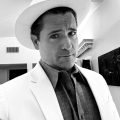
In this second installment, freelance writer Charlie Cy describes a specific encounter escorting a passenger for Lyft, who distilled some ugly truths about our city, while en route to his home from the UofL ER.
From Shawnee to Parole Office – Signs of the Derby Exodus – Ladies of the Thoroughbred Lounge – Which Side Are You On – 1984 Telescreen – UofL ER – Can of Pork and Beans – Panic Attack and Orishas – Street Caste – Wayne’s Story
I GOT ON THE ROAD before six that morning. Overnight, tornadoes had struck outside of town. It was still dark out, but the air was already hot and saturated with humidity.
By eight, I’d given a half-dozen rides. Dropped off a mother and daughter at a day care. Drove several fellow plebes to their first shift assembly line jobs: one to Reynolds Aluminum in the tight industrial corridor along the train tracks off Hale Avenue in the Parkland neighborhood; the other to GE’s giant 1000-acre Appliance Park campus off Beuchel—a one-way maze littered with speed bumps and stop and go traffic lights running along football fields of fencing and turnstiles that felt at times more like sinister gateways in and out of a prison rather than a place where free workers manufactured dishwashers and refrigerators.
Afterwards, I shuttled a young buck no older than nineteen – armed with a coy, Mona Lisa smile and shackled with an ankle monitor – out from his home in Shawnee, two blocks from the storied Ohio (that never-ending physical reminder of what once divided the land of the slave from the land of the free), to his parole office appointment in a strip mall within spitting distance of the freshly hollowed-out brainstem of downtown.
Just four days earlier, the 150th running of the Kentucky Derby commanded every inch of the city’s consciousness and physical anatomy. But now the festive, bacchanal boom-town spirit of excess had shriveled up like a tortured detainee’s penis.
One-hundred-thousand-plus booze-crazed, ego-deranged spectators from around the globe had descended upon our little Southern postage stamp. And just as fast as the glut of money and mobs rolled in, they U-turned, hungover, in one mass exodus.
Accordingly, deflationary pressures could be felt throughout the city and on every economic rung. The symmetrical rows of private jets lining the tarmac at Muhammad Ali International and its overspill of birds parked across town at Bowman Field had all flown the coop. Booked to capacity and printing money days prior, visitors and locals could again commandeer a room at the Galt House or Brown Hotel, or book a table at Jeff Ruby’s to enjoy a splashy Wagyu ribeye and lobster tail dinner in the Art Deco cocaine-and-martini-chic steakhouse environ, without needing to know someone on the inside.
Likewise, the sportsbooks and parimutuel counters at Churchill Downs and Caesar’s across the river in Indiana, previously busy catering to coiffed whales sucking on phallic cigars had returned to accommodating the local crustaceans. Even the magnificently seedy Shively strip clubs like the Thoroughbred Lounge were sending the ladies back outside to solicit the denizens passing by on Seventh and Berry Boulevard.
But other signs hit closer to home. The lofty driving rates for Uber and Lyft, like Icarus had fallen back to earth, and as the demand cratered, margins tightened. Nevertheless, Silicon Valley’s snakes continued to take upwards of 60 percent of the cut of the passenger’s total fare no matter the pickings.
It was always the drivers, their de facto workforce, who first got squeezed, thanks to the cunning engineering of independent contracts manipulated by high-powered lawyers and lobbyists who skirted almost every labor protection instituted before or after Florence Reece began singing “Which Side Are You On” in Harlan County in 1931 for the United Mine Workers.
Nevertheless, I needed whatever money these bloodsucking leeches were offering, a fact they mercilessly exploited, and regardless, there was no manager to complain to or HR hotline to call, and so like Winston in “1984,” I took my marching orders from the telescreen of my iPhone and at 8:23 AM, accepted my next ride directing me to the University of Louisville hospital emergency room downtown to pick up a passenger named Wayne.
The UofL ER is the only Level I trauma center in the state and routinely treats gunshot victims. Moreover, I’ve chauffeured my share of employees – from security guards to janitorial staff to nurses (as well as several patients) – to and from this hospital and always try to pry them open like a can of pork & beans to pick their brains because there is no shortage of terror and mayhem that visits their workplace.
They are often all-too eager to share their grisly stories, among other episodes of incompetence or outright malfeasance—including unverified accusations of certain doctors and nursing staff behaving like detached robots, and who at times, appear to lack the empathy-gene necessary for patient care, let alone upholding their Hippocratic oaths, an allegation undoubtedly exacerbated by the horrors of the pandemic that overtaxed front-line medical personnel and stretched ranks thin.
I should underscore, these various employees from the ER who’ve spilt their guts to me while en route to their next destination and found themselves sunk into my back seat that doubles as a therapist’s chair, minus the hefty surcharge or shrink babble, are often from the communities where the trauma originally goes down and that bleeds into their workplace. So, I am inclined to trust their instincts, even if at times it’s presented through their own prejudicial lenses and devoid of the doctors’ sides of the stories.
This is especially the case, because I too have been a patient of this institution after suffering from something of an impromptu panic attack several years back, and my less-than-copacetic experience comports with their own anecdotal analysis.
At the time of my brief foray into madness, even before I got to the hospital, I was confronted with a cavalier “healthcare” culture, when asked by a team of aloof, Law-and-Order-prone paramedics parked in the alleyway behind my girlfriend’s condo, “Which hospital do you want to go to?”
I answered without hesitation, “Take me to UofL.” My directive immediately produced a noticeable mirth amongst the pack of wolves, who looked at each other and smirked, while making several sarcastic and indecipherable off-the-cuff comments—but I was neither in on the joke nor in the mood for wordplay. I needed a professional hand, an empathetic ear and a heavy pedal foot, as opposed to a joy ride with a clan of cynical hillbilly ambulatory personnel speaking in condescending and nihilistic code about some avatar dubbed “Lucy,” used to personify the vile orishas in this particular hospital in which I’ve requested to be treated. But I had to make do with the paramedics I was provided. Que sera sera!
I’d never required ER services before in the Commonwealth, and so I assumed, foolishly, the top trauma center in the state run by the university would be the best equipped to treat a meltdown. I was uninitiated. But that is a separate story and a tangent worth exploring for another day. Suffice it to say, I’m initiated now and won’t be returning, unless I’m shot, which isn’t out of the question in this gun-fucked town.
As I approached the ER’s driveway to pick up Wayne, an outspoken man from the street with incredibly powerful vocal cords, wearing a bright orange t-shirt, was shouting indiscernible gibberish into the morning ether, while blocking my path of forward progress. I could tell if I tried to humbly ask this gent to kindly step out of the street and onto the sidewalk, I’d provoke his ire, so, I waited patiently to let him release his demons and go on his way before proceeding.
Within a half-mile radius, the hospital is surrounded by low-income housing, homeless shelters, rehabilitation clinics and newly uprooted homeless encampments—as you likely know, the encampments get perennially torn down and cleared out, and particularly weeks before the Derby to provide the city with the manufactured patina it requires to present a facade of Southern Civility to the world.
Which is to say, this hospital serves and is surrounded by a wide net of dislocated poor people, often with substance abuse and mental health disorders; and therefore, like a magnet, attracts various unique behaviors outside its doors, common to those living on the underbelly of civilization: behaviors ranging from petty panhandling, public intoxication and uncontrollable out of body experiences, to suspicious huddles, nefarious handoffs, brief melees, shooting fentanyl, jacking off or taking a shit on a street corner in broad daylight—I’ve witnessed all of the above. And I never look away.
Truth be told, I’ve never known if or rather when I would join this lot of Down and Out kinfolk, because I’ve always suspected, quite presciently, from a very young age, I was only one foul mix-up away from becoming Dispossessed myself—being a nomadic rummy on the run from my early programming for over two decades can have that effect.
Accordingly, out of a mix of empathy and/or self-preservation, I’ve shared a quiet affinity with the destitute.
And so, after the outspoken man slowly meandered along, I pulled into the loop and under the hospital awning and immediately spotted my passenger, Wayne, sitting on the lone bench clutching a cane in one hand and a backpack and several flimsy and overstuffed white plastic grocery bags packed with clothes and cables in the other.
When he saw me pull to the curb, he immediately popped up and made his way to the car. I threw the gear shift in park. Turned down WUOL, the local classical music station. Put on my hazards and reached back and opened the door for him.
Using his cane as a pole vault, he flung himself like a bear into my cream-colored leather backseat.
“Howdy, Wayne!”
“Good morning,” he responded in a soft, neutral tone, his breathing belabored.
Wayne was heavy-set, looked to be in his late forties or early fifties, was dark-skinned and sweating from his brow.
He quickly got situated, placing his effects awkwardly on his lap like he was hoarding them from thieves. His movements were economical, especially for his size. But he looked uncomfortable, so I asked if he was ready to disembark, thinking he might need a minute to reposition. He said he was good. So off we went, following the app’s directions on my phone cradled on the dash.
We were heading across town several blocks past Ninth Street, the north-south artery that divides downtown from the West End. After turning on Madison, I pulled up to the four-way stop at Hancock. Checked both directions of traffic, and the asked in a tender, not-trying-to-pry-while-prying voice, “Did you just get out of the ER?”
“Yeah.”
Turning north on Hancock towards the river, I looked in the rear-view mirror, and followed-up, “You alright?”
“My blood pressure was high. So, they sent me all the way over here.” He sounded exasperated. His shoulders were slumped. Eyes glazed. But his demeanor was languid and easy.
“How long were you in there?”
“Not more than two hours.” He sucked on his teeth. “Then they sent me on my way.”
“Did they take good care of you?”
“They gave me some blood pressure medicine,” he replied in a disgusted lilt.
We crossed over Muhammad Ali Boulevard and headed several more blocks north up to Jefferson.
“Are you prescribed blood pressure medicine?”
“Yeah, but I ran out. Do you mind if I roll the window down?”
“No. Please. Do you want me turn up the AC?”
“No, I just need some fresh air.”
I turned west on Jefferson. From there, save for two turns onto Market Street, it was a straight shot down the wide boulevard to Wayne’s destination.
Driving under the I-65 overpass, where it was common to see tents erected along the now vacant sidewalks adjacent to Wayside Christian Mission, he began to detail on his own volition, “It was just so hot in there. They just have people all crammed in.”
“Where? In the ER?”
“No. At the detox facility I had to go to. As soon as I got out of there, my pressure went down naturally.”
“How high was it?”
“220 over 190.”
“Fuck!” I blurted out, registering my shock like a reactionary child devoid of manners, not comprehending that someone’s pressure could get that high. “Did you feel sick?”
“Nah, I didn’t feel a thing. The silent killer. That’s what they call it, right?”
“So, how did you know it was up?”
“They routinely check your blood pressure in there. And once they saw it, they called the paramedics. Another bill I’m going to have to pay. And for what? I didn’t need anything but some AC.”
“Damn. Drinking is hard to quit ain’t it?”
“Sheeeeit!” He grinned a wry smile, showing off the gaps in between his yellowed teeth. “The hardest. Ain’t nothing harder.”
“Are we going to that facility now?”
“No, we’re going to my home. I’m not going back in there.”
“I don’t blame you. Was it outpatient or inpatient?”
“Inpatient. Supposed to be in there for five days. Was sober before that for two months but something . . .” He paused. “Something tragic happened. It was just too much. Started drinking again.”
“I’m sorry to hear that.”
The conversation came to a natural lull as we approached the busy intersection of Second Street. Stopped at the traffic light, a low cacophonic drone from a string section poured out of the radio. Violins were maniacally slurring a scale of sharp, high-pitched notes that filled the jagged void in our chat as the word “tragic” tumbled around my brain, waiting for the light to turn.
What happened? I wondered to myself.
Crossing the street, we remained silent as we passed the LMPD patrol station and then the convention center, the Marriot and a thoroughbred mural.
Several more lights disappeared in the rearview mirror as we approached Metro Hall, across from Jefferson Square Park, where activists gathered for months-on-end to protest the murders of Breonna Taylor and George Floyd, and where I too was tear gassed, while documenting the scene.
“Did you lose a loved one?” I finally rejoined.
“Yeah, my stepbrother. Got shot in the neck and the back.”
“Damn. I’m sorry man.”
“Thanks.”
“Were y’all close?”
“Yeah. We were close.”
“Was this a case of just being in the wrong place at the wrong time?”
“I’d assume so!” He said with some perturbed bite.
“Did the shooting happen in Louisville?”
“Portland.”
“The neighborhood of Portland?”
“Yep.”
Portland was one of the more eclectic, impoverished and crime-ridden sub-neighborhoods of the West End in which I drove; inundated with meth, fentanyl, guns, street and biker gangs and a place not uncommon to witness Confederate Battle flags audaciously flown from front yard flagpoles adjacent to urban public schools amidst the tenuous mashup of working-class whites and blacks living in close quarters in old shotguns, row houses and bungalows smooshed on top of each other along the river.
“Man, this town is hot,” I said.
“You know it is. This town is dangerous.” He laid into the word dangerous.
“People don’t know how dangerous it really is, do they?”
“Nah, they don’t.”
“You from Louisville?”
“Nah. I’m not from here.” He paused a beat. “I fucking hate this place.”
For some reason, after all my prying questions, I thought it inappropriate to ask where he was originally from. It was the next obvious question. But it seemed oddly uncouth and too personal to remind him of where he wasn’t.
“This city can suck you in,” I opined instead.
“Mmhmmm.”
We were now stopped at the light at Jefferson and Ninth, at the city’s continental divide.
“But if you’re out in the game, you better see it coming.”
“He was in the game?”
“You’d have to be, wouldn’t you? Shot up like he was.” Again, more disgust resounded from his voice.
“I suppose so,” I said hesitantly. “Was anyone else shot?”
“Nah, just him.”
“Did they ever find the killer?”
“Sheeit mannnn! This is Louisville! Come on now. They don’t even fucking care. They want us killing each other.”
“Did it make the news?”
“Man, I don’t even know. My family tried to get a hold of me when it happened, but they couldn’t track me down. So, I never got a chance to check.”
Up ahead, there was construction on Jefferson that narrowed the road to one lane. As I merged, another ride popped up on my phone screen and when I swiped to reject it, I began to miss my turn and had to brake hard, throw it in reverse, backtrack and then apologize, throwing one hand up, nonverbally asking for forgiveness.
Wayne, unfazed, nodded his head and watched me double-back. Loop around onto Market Street. And then pull over to his apartment complex, now pointed east towards downtown.
“Right here?”
“Yes sir.”
“Well, I hope your health improves Wayne. Sometimes, you just need a drink.”
“You know it. You have a good one. I assume your day is just beginning?”
“It is.”
“Alright now. Stay safe out here in these streets.”
I pulled off down Market Street and low and behold my next ride took me to Portland.
Related Stories

Chemical Spill Turns Creek Red In Riverside Gardens, With Investigation Ongoing

Notes from the Road: Revelations of a Lone Louisville Lyft Driver – Part III
This article appears in Jan 17-30, 2025.